














Introduction to Tier 1 – Tier 4 Data Centers
Discover the definitive guide to Uptime Institute's Tier 1 to Tier 4 data center classifications. Understand the N, N+1, and 2N configuration frameworks, along with critical engineering requirements for power, voltage, continuous cooling, water consumption, land size, and mission-critical applications like AI, military, and cloud warehousing.

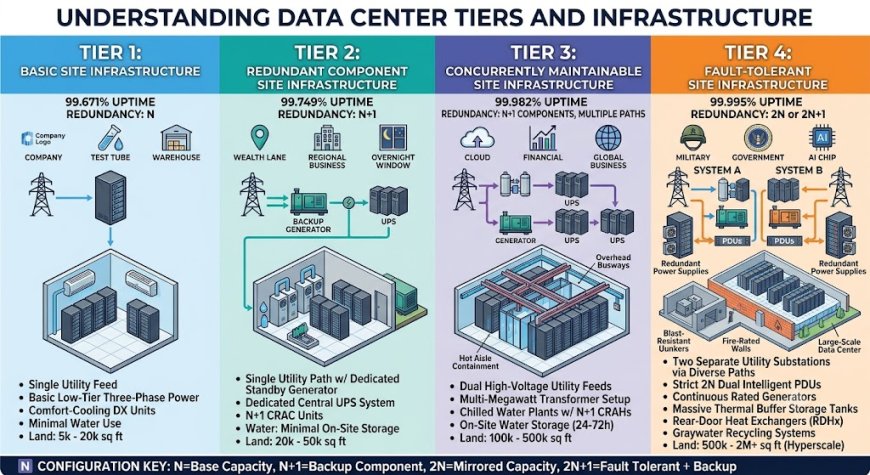
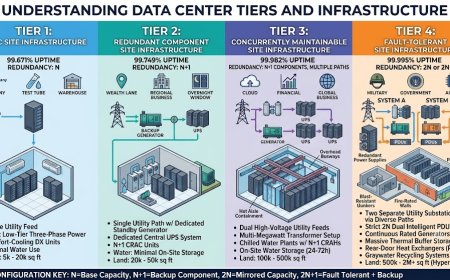
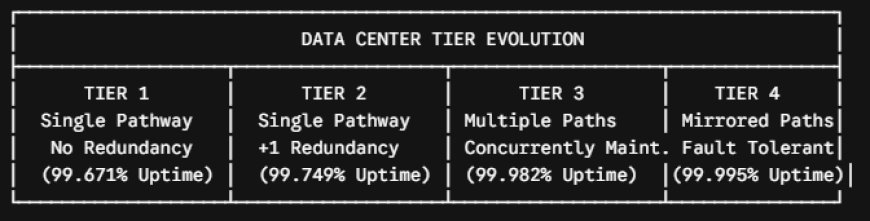
As a facility moves from Tier 1 to Tier 4, the engineering transitions from basic, single-path infrastructure to complex, autonomous, self-healing networks capable of surviving catastrophic hardware failures without dropping service.
Part 1: Demystifying Redundancy - The "N" Configuration Framework
To understand data center tiering, one must first understand the mathematical language of redundancy known as the N Configuration Method (TierPoint, 2023).
-
N (Base Capacity): The minimum baseline of critical infrastructure required to power, cool, and support the data center under full IT load (TierPoint, 2023). If a facility requires exactly 4 chillers and 3 generators to run normally, N = 4 chillers and N = 3 generators.
-
N+1 Redundancy: The facility features the base requirement plus one extra backup unit (TierPoint, 2023). If a chiller fails or is taken offline for maintenance, the "+1" seamlessly takes over. In this setup, an outage risk increases slightly during maintenance because the backup is actively deployed.
-
2N Redundancy (Mirrored Capacity): The facility deploys twice the amount of infrastructure required to meet the full load (TierPoint, 2023). It consists of two entirely independent, parallel systems: System A and System B (CoreSite, 2024). Each side independently handles 100% capacity. Under normal operations, both systems run concurrently at 50% load. If System A is destroyed, System B instantly carries the full 100% capacity with zero disruption (CoreSite, 2024).
-
2N+1 (Fault Tolerant + Backup): The absolute peak of resilience. It incorporates a mirrored system architecture (2N) while also integrating an additional backup component (+1) on each side (CoreSite, 2024). If System A fails and an extra component on System B breaks during the failover transition, the facility still operates without dropped packets.
Part 2: Comprehensive Guide to Tier 1 – Tier 4 Data Centers
Tier 1: Basic Site Infrastructure
Designed for small businesses, local testing environments, or non-critical storage. Tier 1 facilities offer no protection against unexpected equipment failures.
-
Uptime Guarantee: 99.671% annual uptime (approx 28.8 hours of permissible downtime per year).
-
Redundancy: N (Zero backup components).
-
Power & Voltage: Typically connected to a single local utility grid line. High-voltage power enters via a single transformer setup and is distributed as single-phase (120V/240V) or basic low-tier three-phase (208V/120V) (TierPoint, 2023). There is minimal or no centralized UPS capacity.
-
Cooling & Water: Uses standard comfort-cooling DX (Direct Expansion) air conditioning units, similar to commercial office buildings. Water consumption is exceptionally low because they avoid large evaporative cooling towers, relying instead on ambient air exchange.
-
Typical Land Size: Small, localized footprints. Often ranges from 5,000 to 20,000 square feet, frequently embedded inside an existing corporate headquarters.
Tier 2: Redundant Component Site Infrastructure
A middle tier suited for regional businesses that require better data stability but can still tolerate brief, scheduled maintenance windows overnight.
-
Uptime Guarantee: 99.749% annual uptime (approx 22 hours of permissible downtime per year).
-
Redundancy: N+1 (Contains backup pumps, valves, and generators).
-
Power & Voltage: Single utility path but includes a dedicated standby diesel generator and a localized central UPS system. Power distribution transitions smoothly into standard industrial three-phase configurations (208V or 480V) (TierPoint, 2023).
-
Cooling & Water: Incorporates dedicated CRAC (Computer Room Air Conditioning) units in an N+1 configuration. Basic chilled water loops may be utilized, requiring minimal on-site water storage, typically relying purely on continuous municipal supply pipelines without dedicated emergency reserves.
-
Typical Land Size: Generally spans between 20,000 to 50,000 square feet.
Tier 3: Concurrently Maintainable Site Infrastructure
Designed for major cloud service providers, financial institutions, and global enterprises. The defining metric of Tier 3 is Concurrent Maintainability (CoreSite, 2024). Any single component, including a major power line, a chiller, or a UPS battery bank, can be shut down for maintenance or replacement without impacting the servers (CoreSite, 2024).
-
Uptime Guarantee: 99.982% annual uptime (approx 1.6 hours of permissible downtime per year) (CoreSite, 2024).
-
Redundancy: N+1 components running across multiple independent distribution paths (though only one path is actively powering the servers at any given time).
-
Power & Voltage: High-voltage utility feeds enter at medium levels (such as 13.8 kV or $34.5 kV), which are then stepped down via heavy-duty on-site transformers to 480V / 277V three-phase power for maximum distribution efficiency (TierPoint, 2023). Dual power paths lead up to the server racks.
-
Cooling & Water: Utilizes robust Chilled Water Plants featuring dual-fed CRAH (Computer Room Air Handler) units mapped into Hot/Cold Aisle Containment systems. Large-scale cooling towers are standard. Because industrial data centers can consume hundreds of millions of gallons of water annually, Tier 3 facilities incorporate dedicated on-site water storage tanks capable of keeping the cooling loop alive for up to 24 to 72 hours if municipal lines are severed (EESI, 2025).
-
Typical Land Size: Substantial footprints, ranging from 100,000 to over 500,000 square feet, laid out in multi-story or sprawling multi-building campuses.
Tier 4: Fault-Tolerant Site Infrastructure
The highest tier of infrastructure execution, standard for national security operations, hyperscale AI training facilities, and global financial clearings. Tier 4 is completely Fault Tolerant (CoreSite, 2024). If an unexpected blast, fire, or catastrophic failure occurs in any component room, the facility self-heals autonomously with zero human intervention (CoreSite, 2024).
-
Uptime Guarantee: $99.995% annual uptime (approx 26.3 minutes of permissible downtime per year) (CoreSite, 2024).
-
Redundancy: 2N or 2N+1 (CoreSite, 2024). Two fully mirrored, physically isolated infrastructure systems divided by 2-hour fire-rated structural walls.
-
Power & Voltage: Powered by two entirely separate utility substations running over geographically diverse grid pathways. Medium voltage (13.8 kV to $34.5 kV) enters separate, blast-resistant electrical bunkers (TierPoint, 2023). Every rack is armed with dual Intelligent PDUs connected to Source A and Source B, backed by Continuous Rated Generators and online double-conversion UPS systems.
-
Cooling & Water: Continuous cooling is mandatory. This is achieved by integrating massive, pressurized Thermal Buffer Storage Tanks directly into the chilled water loop to neutralize heat spikes instantly while generators spin up. For high-density AI clusters, Tier 4 implements Liquid-to-Liquid cooling and Rear-Door Heat Exchangers (RDHx). Water usage is massive, large hyperscale sites can use up to 5 million gallons of water per day (EESI, 2025). They maintain independent, subterranean well connections or massive localized graywater recycling systems to assure continuous thermal dissipation.
-
Typical Land Size: Massively scaled hyperscale campuses. These footprints routinely extend from 500,000 to several million square feet, requiring massive tracts of land to isolate fuel depots, multi-megawatt substations, and mechanical yards safely.
Part 3: Deep Dive Summary Matrix
| Metric / Feature | Tier 1 | Tier 2 | Tier 3 | Tier 4 |
| Redundancy | N | N+1 | N+1 Components, Multi-Paths | 2N or 2N+1 (Fault Tolerant) |
| Annual Downtime | < 28.8 Hours | < 22 Hours | < 1.6 Hours | < 26.3 Minutes |
| Voltage Levels | Single-Phase 120V/240V or 208V | Three-Phase (208V or 480V) | Medium-to-Low 13.8 kV - 480V) | Dual Medium Substation Feeds (34.5 kV - 480V) |
| Cooling Method | Standard Air Comfort Units | N+1 CRAC Air Units | Chilled Water Loop & Containment | Continuous Cooling w/ Thermal Storage or Liquid-to-Chip |
| Water Strategy | None (Air-cooled) | Direct Municipal Feed | On-site backup storage (24-72h) | Massive dual-source storage, wells, or recycled loops |
| Average Land Size | 5k - 20k sq ft | 20k - 50k sq ft | 100k - 500k sq ft | 500k - 2M+ sq ft (Hyperscale) |
| Maintenance Impact | Complete site shutdown required | Scheduled night windows | Zero impact on critical IT load | Zero impact; fully autonomous failover |
The selection of a data center tier is strictly driven by the catastrophic risk and financial impact of a system outage.
Tier 1 and Tier 2 facilities, with their single-path distribution architectures, are typically utilized for non-mission-critical workloads where brief operational disruptions can be tolerated; these include localized data warehousing, software development staging environments, backups, and small-scale business applications. Moving up the scale,
Tier 3 data centers serve as the standard backbone for the modern digital economy, making them the preferred choice for commercial cloud providers, large-scale data warehousing, e-commerce platforms, and fast-growing Artificial Intelligence (AI) training pipelines that require high density but can handle rare, brief, or gracefully managed interruptions. At the absolute pinnacle of infrastructure,
Tier 4 facilities are strictly reserved for workloads demanding flawless, uninterrupted fault tolerance. Because a single second of downtime could trigger national security crises or systemic financial collapses, Tier 4 architectures are mandated for military command and control systems, government intelligence networks, critical national infrastructure, and massive hyperscale AI clusters conducting real-time inference for autonomous global networks.
References
-
CoreSite. (2024). Breaking down data center tier level classifications. CoreSite Blog.
-
Environmental and Energy Study Institute (EESI). (2025). Data centers and water consumption. EESI Articles.
-
TierPoint. (2023). Understanding key elements of data center power distribution. TierPoint Infrastructure Insights.
Algene Toh
+65 90088002
admin@bsr2.com
What's Your Reaction?
 Like
0
Like
0
 Dislike
0
Dislike
0
 Love
0
Love
0
 Funny
0
Funny
0
 Angry
0
Angry
0
 Sad
0
Sad
0
 Wow
0
Wow
0